

A room full of future: what young geoscientists learn at the Summer School
By Tigo Sanchez, CMO · with Simona Miccolis and Davide Murano
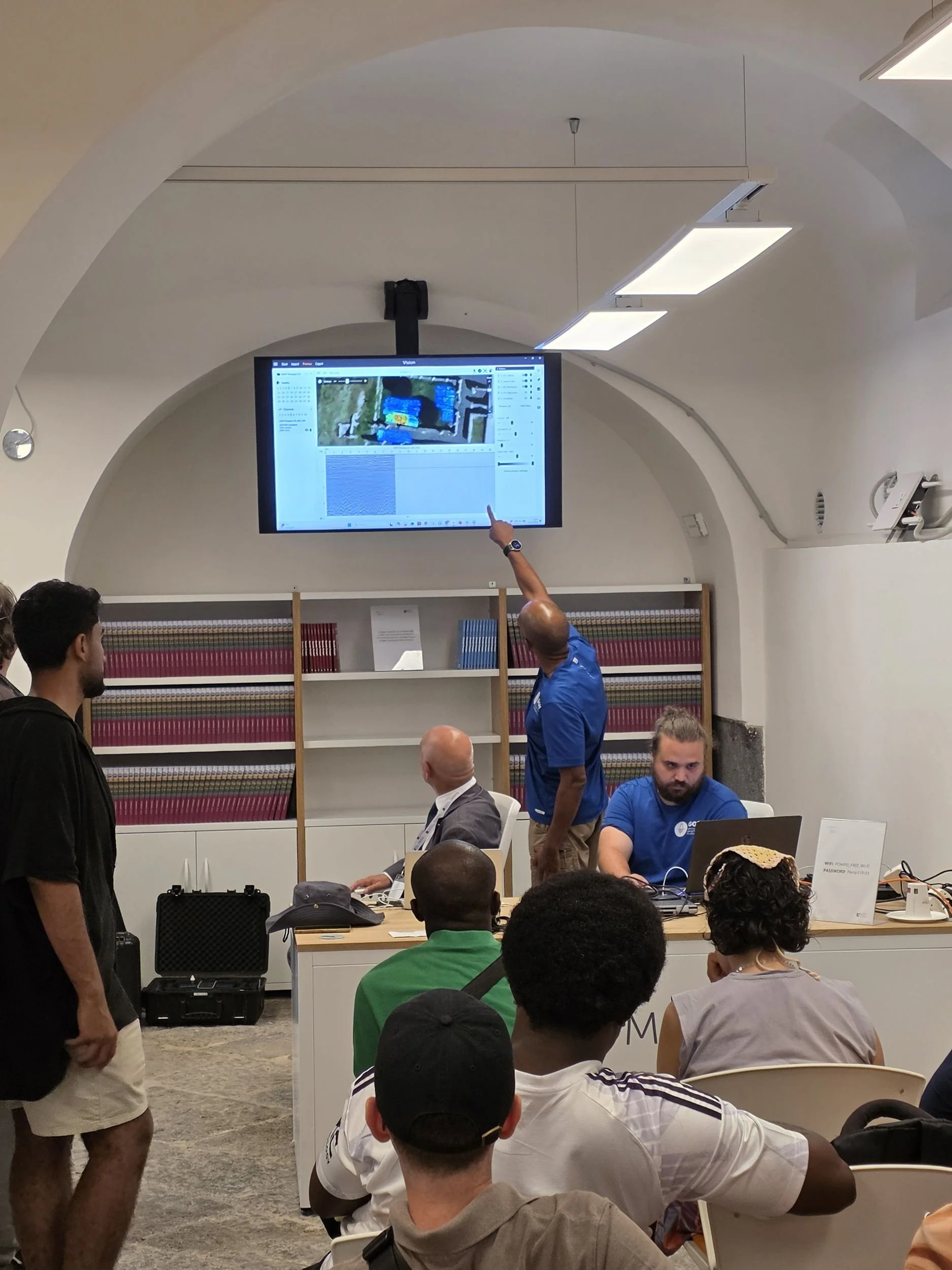
Around a screen, a group of students leans towards the same data. For a moment the light makes it almost theatrical. What matters is real: this is where the next generation learns to look deeper, and to doubt what it sees.
What is the International Training Summer School — Archaeology, Caves & Hypogea?
Short answer. An international training programme that turns real archaeological sites into working laboratories for surveying, documentation and interpretation. It is organised by COIFA, based in Bari, and the "King Mihai I" University of Life Sciences in Timișoara, Romania. The 2026 edition, the seventeenth, ran from 20 May in Naples to 31 July in Timișoara.
The school brings together universities, surveyors, researchers, young professionals and specialists from different countries. It was built and is led by Pietro Grimaldi, Cultore of Architectural Photogrammetry at Politecnico di Bari and Associate Professor of Photogrammetry at UȘAMV Timișoara. GGM.EARTH contributed to the 2026 edition with its survey team and instruments, including the preparatory survey of the Domus dei Gladiatori in Pompeii.
What do participants learn?
Short answer. A method before a tool. The sequence is site context, survey design, acquisition, data processing and interpretation. Participants see how different geophysical and geomatic methods contribute to the same model, and learn to correlate signals, question anomalies and build an interpretation they can defend.
The classroom is where the methodology starts. In the field, the same principles become practical: why a radar line is spaced the way it is, why every dataset needs coordinates, why an anomaly is a question and not an answer.
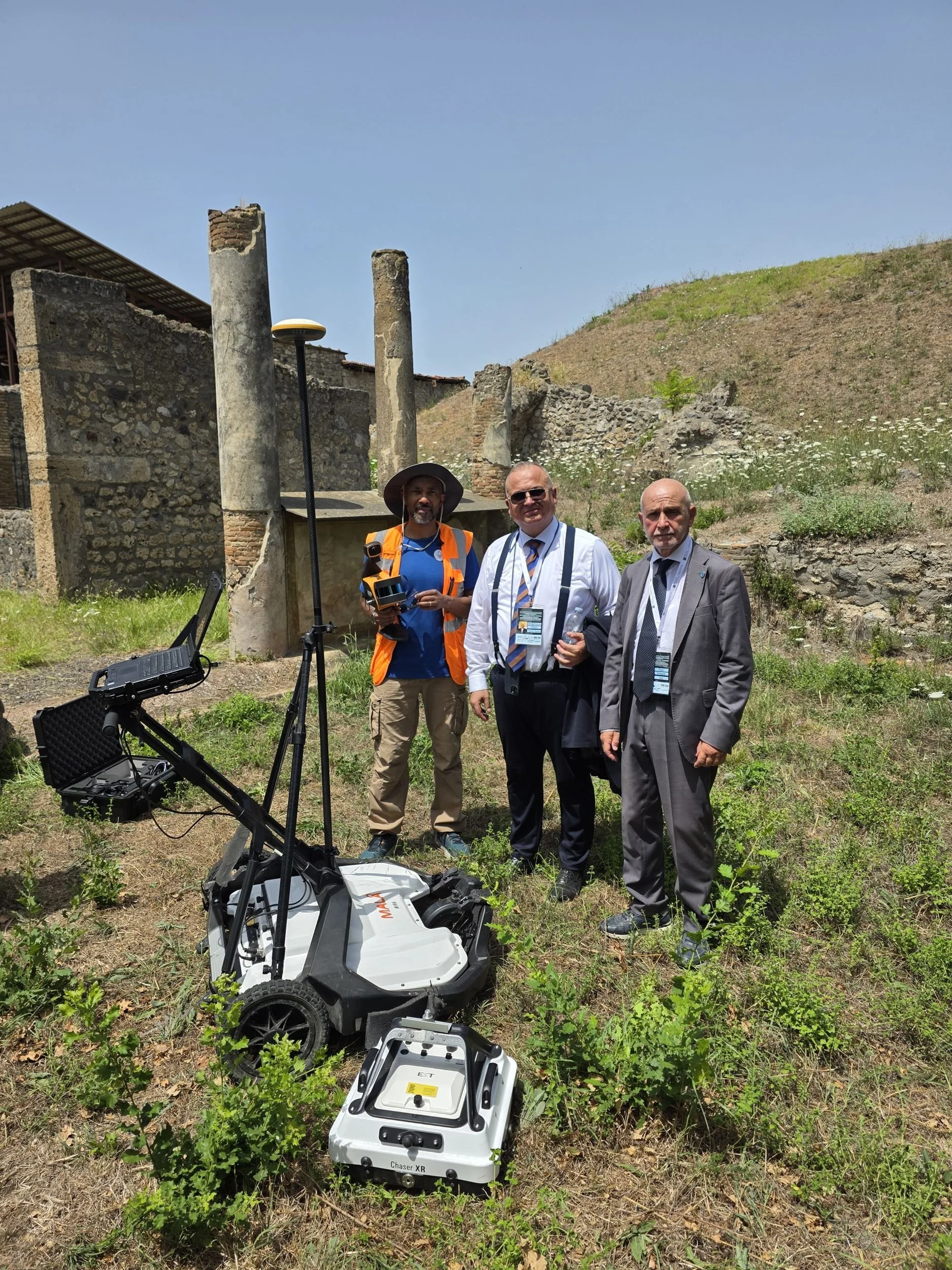
Chewe Chilufya, Co-CEO of GGM.EARTH, Prof. Pietro Grimaldi, director of the Summer School, and Prof. Cosmin Alin Popescu, Rector of the “King Mihai I” University of Life Sciences in Timișoara, with the MALÅ MIRA at the Domus dei Gladiatori, Pompeii.
Why does field training matter for geoscience?
Short answer. Because data quality is decided on site. Instrument settings, line spacing, positioning and the operator's reading of the ground shape everything that follows. On a real archaeological site, with visitors, narrow passages and fragile surfaces, students learn constraints no simulation teaches.
It matters for the profession too. The people in that room will design and read the surveys of the next decades. Teaching them to validate one method with another is the most useful thing a company like ours can bring.
What is GGM.EARTH's role?
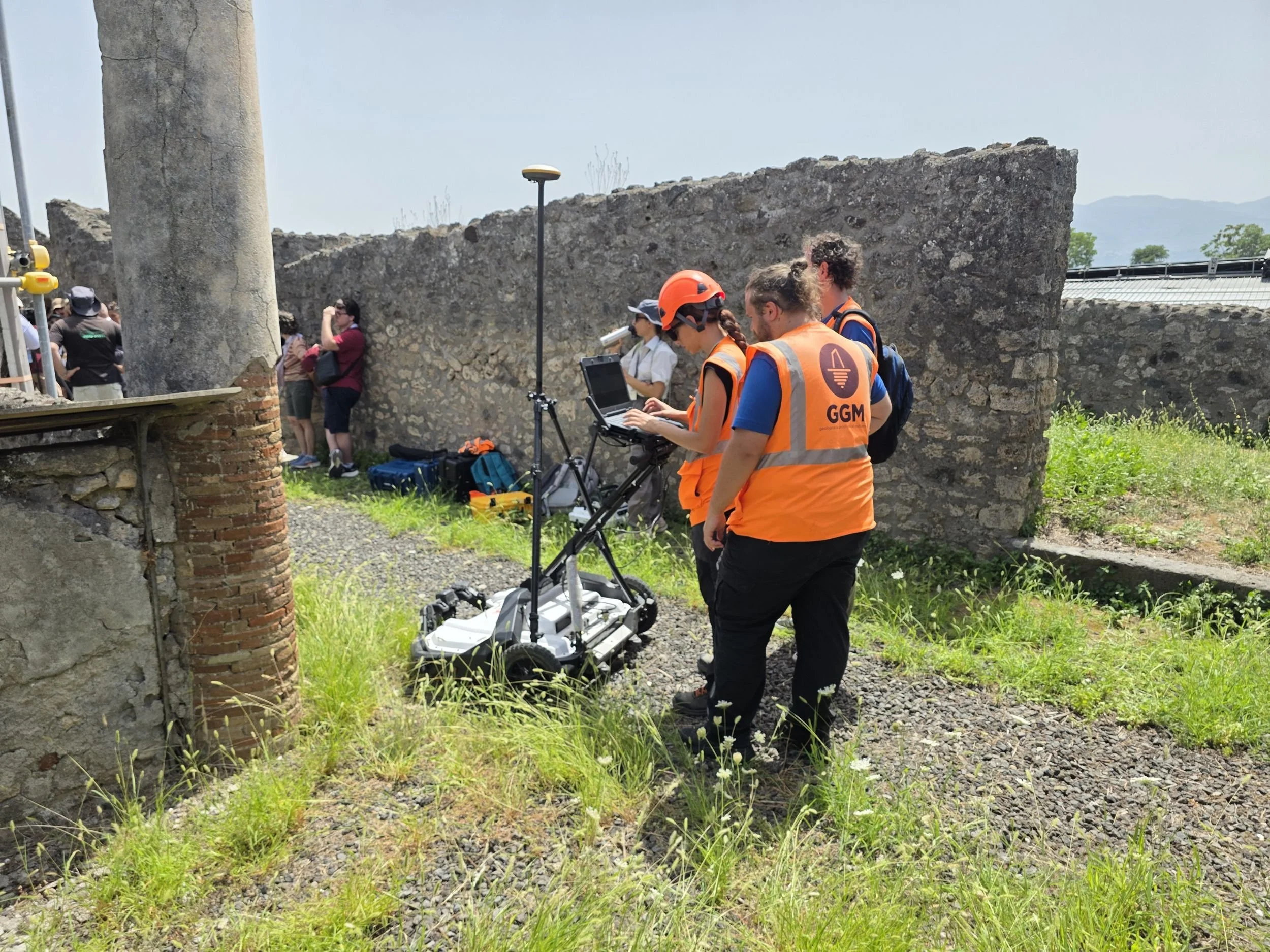
Short answer. We bring survey practice. At Pompeii, in the preparatory work for the school, our team surveyed with UAV photogrammetry, SLAM, two GPR systems and GNSS, and showed how the datasets are processed and integrated. Our aim is the same as the school's: interpretations that hold up because different methods agree.
The next step may be further south. With GGM Surveyors, our Southern Africa Division in Zambia, we are working towards bringing this kind of training experience to Southern Africa.
GPR survey work at the Pompeii Archaeological Park was conducted as part of the XVII International Training Summer School — Archaeology, Caves & Hypogea (https://lnkd.in/epSCpMXz), organized by COIFA (http://coifa.it/), based in Bari, and the “King Mihai I” University of Life Sciences in Timisoara, Romania (https://www.usab-tm.ro/en).
FAQ
Who can take part?
The school brings together students, young professionals, researchers and specialists. Admission details are published by the organisers (coifa.it).
Where does it take place?
On real archaeological and underground sites. The 2026 edition ran from 20 May to 31 July, starting in Naples and concluding in Timișoara.
What is a hypogeum?
An underground space built or used by people: tombs, cisterns, tunnels, cellars. Surveying hypogea combines laser scanning, SLAM, photogrammetry and geophysics.
Related: Pompeii, Domus dei Gladiatori · Summer School: coifa.it · usab-tm.ro/en